Bristol is one of England's most architecturally significant cities. The grand Georgian terraces of Clifton, the Regency crescents of Kingsdown, the magnificent Harbourside warehouses and the medieval street pattern of the Old City — all of these represent a built heritage of extraordinary richness. And an enormous amount of this heritage is still lived in, bought and sold on the open market.
If you're buying a historic or listed building in Bristol, you need a surveyor who genuinely understands what they're looking at. Surveying a Georgian townhouse in Clifton is a fundamentally different exercise from surveying a 1990s new-build in South Gloucestershire — and a surveyor who treats them the same way is doing you a disservice.
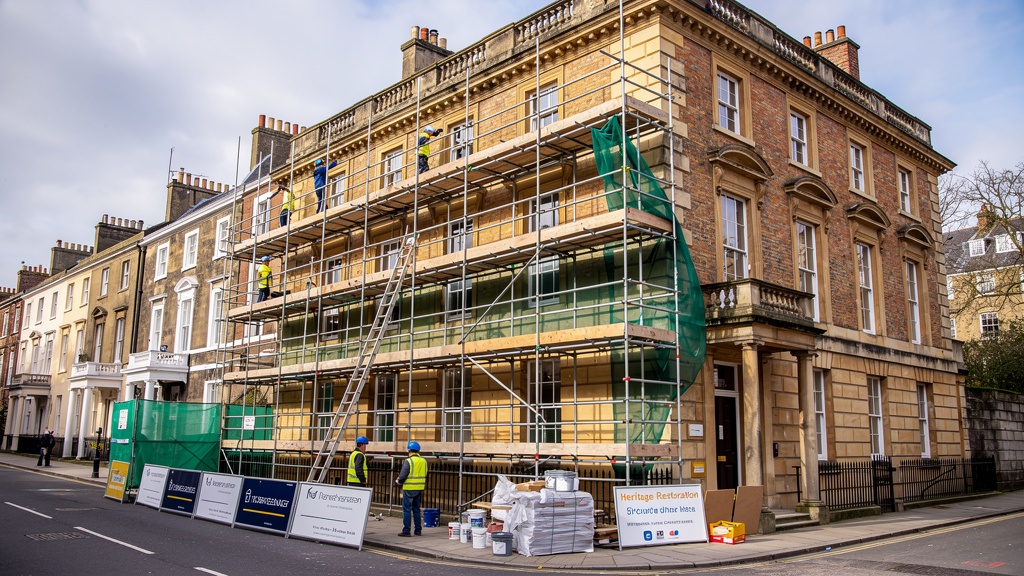
What Makes Historic Buildings Different to Survey?
Historic buildings — broadly speaking, any pre-1919 construction — were built using materials and techniques that are fundamentally different from modern construction. Understanding these differences is essential for accurate condition assessment.
Breathable Construction
The most important principle to grasp about historic buildings is that they were designed to breathe. Solid brick and stone walls absorb moisture and release it again — they're designed to do so. Original lime mortar, lime plaster and lime render all support this breathability. The building was conceived as a whole system that managed moisture through absorption and evaporation rather than exclusion.
Many of the most serious problems we see in Bristol's historic buildings are caused by well-intentioned modernisation — specifically, the use of cement mortars, modern renders and vapour-barrier insulation — that disrupts this breathing system and causes moisture to become trapped within the wall structure. This leads to accelerating deterioration of the masonry, timber and plaster.
Lime Mortar and Pointing
Original lime mortar is designed to be weaker than the stone or brick it bonds. This means that when the building moves slightly (as all buildings do), the mortar cracks and absorbs the movement — rather than transmitting it to the masonry. It also means that failed lime mortar can be repointed relatively easily, without damage to the masonry.
When cement mortar is used to repoint a historic building, the opposite happens: the harder mortar forces any movement into the masonry itself, causing cracking and spalling of the bricks or stone. We see this extensively in Bristol's older properties.
Structural Movement
Pre-1919 properties were typically built on shallow 'strip' foundations that would not be acceptable under modern building regulations. This means that some degree of movement and settlement over the building's life is normal — and expected. The key question, for any building surveyor examining a historic Bristol property, is whether any observed movement is historic (finished and benign) or active (ongoing and potentially significant).
Distinguishing between the two requires experience, specialist knowledge and — sometimes — careful monitoring over time. This is one of the most important skills of a surveyor working in Bristol's historic housing stock.
Listed Buildings: Additional Considerations
A significant proportion of Bristol's historic buildings are listed — Grade I, Grade II* or Grade II. Listed Building Consent (LBC) is required for any works that affect the character of a listed building — including many repairs and alterations that would be entirely unremarkable in a non-listed property.
As a building surveyor advising on a listed Bristol property, it's important to assess not just the condition of the building but also the likely consent position for any works that may be required. Some repairs are straightforward — like-for-like replacement of failed lime mortar, for example. Others — like replacing original timber sash windows with modern double-glazing — would require LBC and, depending on the significance of the building, might not be granted.
This matters enormously for a prospective purchaser. If a listed building in Bristol needs significant roof repairs, for example, the surveyor's report should address not just the cost of the work but also the consent requirements — because the consent process can add time and cost, and in some cases restrict the repair options available.
The Specialist Knowledge Required
Surveying historic buildings in Bristol requires knowledge that goes well beyond the standard residential survey curriculum:
- Understanding of traditional construction materials and methods — lime, stone, brick, structural timber
- Knowledge of common failure modes in historic construction — damp patterns, structural movement, material degradation
- Familiarity with the listed building consent framework and conservation area designations
- Experience in specifying appropriate repair strategies for historic fabric
- Understanding of the ongoing maintenance requirements of a historic building
Our team at Surveyors Bristol has extensive experience surveying historic properties across Bristol and the surrounding area — from the magnificent Georgian terraces of Clifton to the Edwardian suburbs of Westbury Park and the rural historic farmhouses of North Somerset. If you're buying a historic Bristol property, get in touch to discuss your specific requirements.
A Note on Clifton's Georgian Terraces
Clifton's Georgian terraces deserve a special mention because they're among the most beautiful — and most complex — residential properties to survey in the South West. These buildings are typically three or four storeys high, with basements, and were built in the late 18th and early 19th centuries by some of the most skilled builders of the era.
Their complexity lies in their scale, their layered history (most have been significantly altered over two centuries), and the specific vulnerabilities of their construction — particularly the basement levels, which are vulnerable to damp and structural movement. A thorough Level 3 Building Survey for a Clifton Georgian terrace is an extensive and skilled piece of work — and absolutely worth commissioning before exchange.